King’s Quest. Police Quest. Space Quest. These games took up many hours of childhood and often represented a concept that was still nascent in the broader cultural understanding. Problem solving manifested as an avatar in a computer simulation.
Trying to figure out how to move the plot forward required moving through spaces and discovering keys to puzzles, endlessly frustrating but also rewarding. Not unlike how we do things today, only now the stakes are more obvious and the tools more contextualized to suit the non-geek public at large. But we’re still trying to realize how to best interact with today’s ultra-modern systems. Jarvis isn’t yet quite a reality, although the case could be made that all the components are now there, and people aren’t really ready to dive headfirst into an AR world.
So then the idea came along to create all our tools and interactive spaces in a runtime that was compatible with Sierra’s sci0 interpreter. Yes; we wanted to figure out how we could make our own game that could actually be run under the official SCIV.exe, using the exact same formats used by Sierra, but run it in JavaScript. So fully SCIV.exe compatible but targeted for our own “clean room-ish” JavaScript runtime implementation. Again, because it’s just the nerdy thing to do.
This has resulted in a whole IDE being built to author such resources, and at some point we’ll release a Quest game.
But then things got weirder, and we thought about how we could “solve” / finish Quest games simply by inspecting the resources and running them through an engine. Kind of like a chess solver, but supposedly somewhat easier since the constraints and shape of the endgame are known and defined. This led into a whole side quest (p-unintended) of tree/structural representations and eventually an adaptation of Go-Explore. The ultimate use of this is to allow automated testing of our game once we’ve completed it.
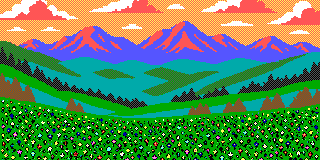
After the game, we might want to have self-generating stories using AI. We’ve built a pipeline that can take images and programmatically convert them into Sierra-style “vector and fill” graphics, so there’s a lot of potential for using an ancient 320x200 graphics space as an interactive space. Maybe there’s a universe where we can model solutions through some game-analogous topology, or render the evening news dynamically into a setting you explore like a Sierra Quest, only online and multiplayer.
The beauty here is that, sure, these are all ideas that can be done using modern tools. But the fun and nostalgia is in finding ourselves back in the very environment (and constraints) that fostered the passion to begin with.